Saturday, April 5, 2008

A Mother's Lament: Alienor of Aquitaine, 1122-1204


Alienor with her son, John "Lackland" (Chapelle Sainte Radegonde de Poitiers)

Alienor, queen of England, widow of Henry II, to Pope Celestine III (1193):

To the reverend Father and Lord Celestine, by the Grace of God, the supreme Pontiff, Eleanor, pitiable and hoping in vain to be pitied, the Queen of England, Duchess of Normandy, Countess of Anjou, entreats him to show himself to be a Father of mercy to a pitable mother.

O holiest Pope, a cursed distance between us prevents me from speaking to you in person, but I must give vent to my grief a little and who shall assist with me with my words? I am all anxiety, both within and without and as a result my words are full of suffering. There are fears which can be seen, but hidden are the disputes, and I cannot take one breath free from the persecution of my troubles and the grief caused by my afflictions, which beyond measure have found me out. I have completely wasted away with torment and with my flesh devoured, my bones have clung to my skin. My years have passed away full of groans and I wish they could pass away altogether. I wish that the blood of my body, already dead, the brain in my head and the marrow of my bones would dissolve into tears, so much so that I completely melt away into sorrow. My insides have been torn out of me, I have lost the staff of my old age, the light of my eyes; if God assented to my prayers he would condemn my ill-fated eyes to perpetual blindness so that they no longer saw the woes of my people. Who may allow me to die for you, my son? Mother of mercy, look upon a mother so wretched, or else if your Son, an unexhausted source of mercy, requires from the son the sins of the mother, then let him exact complete vengeance on me, for I am the only one to offend, and let him punish me, for I am the irreverent one--do not let him smile over the punishment of an innocent person. Let the one who is striking me crush me, lift up his hand and kill me; let this be consolation--that in burdening me with grief he does not spare me. I am pitiable, yet pitied by no-one; why have I, the Lady of two kingdoms, reached the disgrace of this abominable old age? I am the mother of two kings.

My insides have been torn out of me, my family has been carried off, it has rolled past me; the Young King and the earl of Brittany sleep in the dust--their mother is so ill-fated she is forced to live, so that without cure she is tortured with the memory of the dead. As some comfort, I still have two sons, who are alive today, but only to punish me, wretched and condemned. King Richard is detained in chains; his brother John is killing the people of the prisoner's kingdom with the sword, he is ravaging the land with fires. In every respect the Lord has become cruel to me, turning his heavy hand against me. His anger is so against me that even my sons fight against each other, if indeed it can be called a fight when one is imprisoned and crushed in chains while the other heaps grief upon grief by trying to usurp the former's kingdom for himself with his cruel tyranny.

Good Jesus! Who will grant me thy protection in hell and hide me until your fury passes away, until your arrows stop, the arrows which are in me, the arrows whose anger my whole spirit is drunk on? I long for death, I am weary of life. Though I am thus continually dying, I still want to die more completely; unwilling, I am compelled to live--my life is the food of death and is a means of torture. Blessed are those who do not know the capriciousness of this life, who do not know of the unpredictable events in our inconstant fate because of a blessed abortion! What do I do? Why do I yet live? Why do I, a wretched creature, delay? Why do I not go to see the man my soul loves, chained in beggary and iron? At such a time as this, how could a mother forget the son of her very womb? Affection appeases tigers, it even appeases the more fierce witches.

But doubt remains and I waver. If I go, I desert my son's kingdom, which is being plundered from every direction with formidable hostility, and in my absence it will have no common counsel, no relief. But if I stay, I will not see what I most want to see, the face of my son, and there will be no-one to concentrate on procuring the release of my son, but what I am more afraid of is that the most fastidious of young men will be tortured for some impossible sum of money and yet impatient of so much affliction will be easily tortured to death. O wicked, cruel, impious tyrant who is not afraid to lay his hands on the Lord's Anointed, nor has a royal anointing, nor a reverence for the holy life, nor a fear of God restrained you from such inhumanity.

In addition to this, the Prince of the Apostles still rules and reigns in the Apostolic See, and his judicial steadfastness is set up for the people; it rests with you, Father, to draw the sword of Peter against these criminals, for it was for this reason that Peter set the sword above peoples and kingdoms. The cross of Christ soars ahead of the eagles of Caesar, the sword of Peter is a higher authority that the sword of Constantine, the Apostolic See higher than an Imperial power. Is your power derived from God or from men? Did not the God of God's speak to you through his apostle Peter, saying 'Whatever you have bound on earth will be bound also in heaven and whatever you have freed on earth will also be freed in heaven'? Why then have you, so negligent, so cruel, done nothing for so long about the release of my son or is it rather that you do not dare? Perhaps you will say that this power entrusted to you was over souls, not bodies: so be it, I will certainly be satisfied if you bind the souls of those who keep my son bound in prison. It is in you power to release my son, unless the fear of God yields to a human fear. So restore my son to me, man of God, if indeed you are a man of God and not a man of mere blood. If you are slow in releasing my son, then the Most High will require my son's blood from your hand. Alas, it is a sorry time when the chief shepherd turns into a mercenary, when he flies from the face of the wolf, when he abandons in the jaws of a bloodthirsty beast a lamb put into his care, or even the chosen ram, the leader of the Lord's flock. A good shepherd instructs and informs other shepherds not to run when they see a wolf approaching but rather to lay down their lives for their sheep. Please, I beg you, may you save your own soul while you apply yourself to procuring the release, not of your sheep, but I will say of your son, using numerous embassies, beneficial advice, thunderous threats, general injunctions and severe sentences? Though late, you should give your soul for him, the man for whom you have refused to say or write one word. We know from the testimony of the prophet, the Son of God came down from heaven to bring the chained out of the lake in which there was no water; what was fitting for God is surely fitting for God's servant. My son in tortured in chains, but you do not go down to him, you do not send anyone, you are not even moved by the sorrow which moved Joseph. Christ sees this and is silent, but in the final judgment retribution will be severe for those who are negligent in doing God's work.

Legates have now been promised to us three times, yet have not been sent; in fact they are servants rather than legates. If my son were in a prosperous position, they would hurry rather more quickly to his simple call, expecting plentiful rewards for their embassy from his splendid generosity and the public profit of his kingdom. But what profit could they consider more glorious than the freeing of a captive king and restoring of peace to the people, of tranquillity to the religious and of joy to everyone? But now the sons of Ephraim, who aimed, who fired their bows, have turned round on the day of battle and in the time of stress; while the wolf comes upon his prey, the dogs are mute--either they cannot, or they will not, bark. Is this the promise you made me at the castle of Ralph, with the great authority of love and good faith? What benefit did you gain from giving my simple nature mere words, from mocking the prayers of the innocent with a hollow trust? So once King Achab was forbidden to form a friendship with Ben-hadad, and we have heard what disastrous effects their mutual love had. Divince providence blessed the wars of Judas, John, Simon and the Maccabaean brothers with felicitous auspices; but when an embassy was sent to secure the friendship of the Romans, they lost the help of God, and their corruptible friendship was more than once the cause of bitter regret. You alone forced me to despair; after God, you have been my hope, the trust of our people. Cursed be he who trusts in man--so where is my refuge now? You are, my Lord, my God. The eyes of your maidservant are turned to you, O Lord, for you recognise my distress. You, the King of Kings, Lord of Lords, look upon your Christ's face, grant sovereignty to your Son, and save the son of your maidservant; do not bring on him the crimes of his father or the wickedness of his mother.

We know from a certified public report that after the death of the bishop of Liege whom the emperor is said to have killed with a death-blow from his sword, though wielded by a distant hand, he confined in prison-like misery the bishop of Ostia, four of his provincial bishops and even the Archbishops of Salerno and Trieves; and the Apostolic authority ought in no way to deny that unlawfully and tyranically he has also taken possession of Sicily, to the perpetual detriment of the Roman Church--for from the times of Constantine it has remained the patrimony of St Peter, and it was seized despite embassies, petitions and threats from the Apostolic see. The emperor's fury is not satisfied with all these gains, but his hand is still stretched out. Certainly he has done dreadful things, but most surely you can soon expect worse. For those who ought to be pillars of the Church are as light as reeds and every wind sways them. If only they would remember that the glory of the Lord was transferred from Israel because of the negligence of Eli, the priest ministering in Shiloh. That is not a parable applying only to the past, but to the present; for the Lord banished the Tabernacle from Shiloh, his own Tabernacle where he dwelt among men and he left their virtue to remain in captivity, their excellence in the hands of the enemy. The fact that the Church is being trampled upon is attributed to their timidity, as is also the fact that faith is being put to the test, liberty oppressed, trickery being fostered by compliance, wickedness by impunity. Where is the promise the Lord made to his Church: 'Thou shalt suck the milk of the Gentiles and shall suckle the breasts of Kings; I shall make thee the pride of ages, a joy from generation to generation'? Once, the Church trod upon the necks of the proud and lofty with its own strength and the laws of emperors obeyed the sacred canons. But now things have changed--not only canons, but the makers of canons are restrained by base laws and profane customs. No-one dare murmur about the detestable crimes of the powerful, which are tolerated, and the canonical rule applies merely to the sins of the poor. So Anacharsis the philosopher had good reason to compare the laws and canons with spider's webs, which trap the weaker animals but let the stronger go.

The kings of the earth have set themselves and the rulers have all agreed to be against my son, the Lord's Anointed. One tortures him in chains, another destroys his lands with a cruel enmity, or to use a common phrase: 'one shears, another plunders, one holds the foot, another skins it.' The supreme Pontiff sees all this, yet keeps the sword of Peter sheathed, and thus gives the sinner added boldness, his silence being presumed to indicate consent. For the man who can rebuke, who ought to rebuke, but does not do so seems to consent, and the man who pretends to be patient will not be without a hidden alliance. The time of dissension is upon us, just as the Apostle predicted and the son of eternal damnation shall be revealed; dangerous times are at hand when the seamless tunic of Christ is torn, when the net of Peter is broken and the solid unity of the Catholic Church is dispersed. These are the initial stages of evil things--we perceive oppressive times, we fear worse. I am no prophetess, nor the daughter of a prophet, but my grief has made many suggestions about the troubles to come; yet it also steals the very words it suggests, for my writing is interrupted by my sobbing, my sadness saps the strength of my soul and it chokes my vocal chords with anxiety. Farewell.

Crawford, A., ed. Letters of the queens of England (UK: Sutton Pub., 2002, pp. 39-43)

Monday, March 24, 2008

Thomas, Lord Berkeley (1353-1417)

Image credit: Nigel Saul

Monumental brass (1392) of Thomas, Lord Berkeley and his wife, Margaret Lisle. Purbeck marble tomb chest in the north aisle of the church of St. Mary the Virgin, Wotton-under-Edge, Gloucestershire.

Thomas Berkeley ("the Magnificent"), son of Maurice, Lord Berkeley and Elizabeth Despencer, at his birth in 1353 brought together the blood of the baronial families of Berkeley, Despencer, Mortimer and Clare--four of the principal dynasties central to the struggle, a generation earlier, between the barons and Edward II. His maternal great-grandmother was Joan of Acre, daughter of Edward I. In November 1367 at Wingrave, Buckinghamshire, Thomas married Margaret, Baroness of Lisle & Teyes. Their only child, Elizabeth, married Richard de Beauchamp, earl of Warwick (d. 1439).

Thomas' resume included an extensive military service, by sea and by land, under Richard II; this service was continued and enhanced under Henry IV. Dugdale says that he was appointed Admiral of the King's Fleet in the 5th year of Henry IV: "He was likewise retained by Indenture to serve the King with three hundred Men at Arms, upon the Sea, for one quarter of a year, himself accounted, with eleven Knights, two hundred eighty five Esquires, six hundred Archers, seven Ships, seven Barges, and seven Ballingers, double manned with Marriners," having command to sail to Bordeaux.


By the terms of his will (1415, cited by Dugdale), Thomas bequeathed "unto the Fabrick of that Church, wherein his body should happen to be buried, a Cross gilt, with all the Relicks included therein. To his Daughter, the Countess of Warick, he thereby gave his best pair of Mattins, as also one gilt Cup with twenty pound contained therein. To James his Nephew (viz. his next Heir-male, being son of James, his brother, already deceased) his best Bed, and great Cup of Jet; as also twenty Coats of Male, twenty Brest-plates, twenty Helmets, and twenty Lances."

About the monumental brass (Monumental Brass Society, http://www.mbs-brasses.co.uk/):

Thomas and Margaret's brass was commissioned in 1392 on the death of Margaret, daughter and heiress of Warin, Lord Lisle. It was conceived as a joint memorial, to the Berkeleys as a couple, although Thomas himself was to live for another 25 years. Thomas’s choice of a brass for his wife is a measure of the high status enjoyed by brasses at this time. Earlier members of his family had all been commemorated by relief effigies – most of them of freestone but in one case of alabaster; and this tradition was to resume under his successors. Brasses, however, enjoyed particular favor with the aristocracy in Thomas’s lifetime.

It is noteworthy that Thomas' sword belt was adorned by a jewel inlay, now lost. Margaret's figure would also have been eye-catching; the crespine headdress had inlaid jewels and the brocade cushions on which her head rest would have had coloured mastic inlay to enhance the design. The collar of mermaids which he is wearing – not a known Berkeley device – may allude to the office of admiral to which he was appointed in 1403. In Thomas’s lifetime the estates of the Berkeley family reached their greatest extent. His wife, an heiress, whom he had married in 1367, brought him the wide Lisle estates in Oxfordshire, Berkshire and Buckinghamshire. On Thomas’s death in 1417 without male issue, however, the Berkeley inheritance was divided between the heir male and the heir general, and the great lawsuit began which was to last for nearly two centuries.

References:

Cockayne, The Complete Peerage, 2:130-31
Dugdale, The Baronage of England, 1:360-61

Sunday, March 23, 2008

Elizabeth de Burgh, Lady of Clare

Pictured: Caerphilly Castle, South Wales, seat of the Clare family in Wales. Built 1270 by Gilbert de Clare, son-in-law of Edward I and father of Elizabeth de Burgh, the castle became the inheritance of Elizabeth's sister, Margaret, countess of Gloucester [picture credit: Jeffrey L. Thomas].

Elizabeth de Burgh (1295-1360), "Lady of Clare" (Domina Clare), niece of Edward II, ranked among the higher nobility. Youngest daughter of Gilbert de Clare and Joan of Acre (daughter of Edward I), she was co-heiress, with her two sisters (Eleanor and Margaret), to one-third of the inheritance of the Clare earls of Gloucester. Married in 1308 to John de Burgh, oldest son of the earl of Ulster, Elizabeth was widowed in 1313. Their son, William, the last earl of Ulster, was killed in Belfast in 1333, leaving a daughter, Elizabeth.

The death at Bannockburn of her childless brother, Gilbert de Clare, meant that Elizabeth came under considerable pressure from fortune hunters as well as her uncle, Edward II, who, under medieval law, controlled the rights to her marriage. This attraction seems to have been the reason for her runaway marriage in 1316 to Thebaud (Theobald) de Verdun, who is alleged to have abducted her from Bristol Castle. Theobald denied this charge, stating that he had been betrothed to Elizabeth in Ireland and that she willingly came out to meet him at Bristol. The marriage lasted five months, Theobald dying in July 1316 at Alton Castle, Staffordshire. Nonetheless, their brief union produced an only daughter (ancestor of this author), Isabel de Verdun, born at Amesbury in Wiltshire in March 1317.

Elizabeth married for a third time to Roger Damory, who, condemned to death as a traitor by Edward II in 1321, though soon pardoned, died in March 1322 without heirs. Elizabeth now entered a period of long widowhood; her status as a widow was assured by her canny decision to take religious vows while still a young woman. This strategy allowed her to escape the fate of another arranged marriage, while at the same time allowing her complete control of her vast estates.

The "Lady of Clare" died in November 1360, age 65, at the Minoresses Convent, Aldgate, London. Some sources erroneously claim that Elizabeth was buried beside her third husband at St. Mary's, Ware, Hertforshire; however, her will shows that she was buried at the Minoresses Convent, originally inside the Abbey Church. By the 16th century, her tomb had been moved to the Cloister [Medieval London Widows, p. 44]. By the provisions of her will, dated 25 Sept. 1355 at Clare, Elizabeth, re-founder of "Clare Hall" in 1338, further endowed the Hall (now Clare College, Cambridge) with money, plate, and books. A year before her death, Elizabeth wrote the statutes of Clare Hall:

Preamble to the Statutes of the Foundress, 1359

Elizabeth de Burgh, Lady of Clare, to all children of Holy Mother Church who read these words: greeting and remembrance of our deed! Experience, the universal guide, plainly shows that learning is no mean advantage in every rank of life, ecclesiastical or civil. Though many people seek it in many ways, it is best acquired in a recognised university community; and when its pupils have acquired it and tasted its sweets, it sends them out well qualified to rise according to their merits to different ranks in church and state. But so many men have been swept away by the ravages of the plague that learning has lately suffered a sad decline in numbers. We, therefore, desiring to assist true religion and to further the public good by promoting learning so far as God has put it in our power to do so, have turned our attention to the University of Cambridge in the diocese of Ely, where there is a body of students. Our purpose is that through their study and teaching at the university they should discover and acquire the precious pearl of learning, so that it does not stay hidden under a bushel but is displayed abroad to enlighten those who walk in the dark paths of ignorance. And to enable the scholars residing in our said college to live in harmony under the protection of a firm discipline and so enjoy greater freedom to study, we have with the advice of experts made certain statutes and ordinances, set out below to stand in perpetuity.
[Clare College History, http://www.clare.cam.ac.uk/about/history.html]

Dugdale, in his Baronage of England (London: 1675), v. 1, pp. 474-75, transcribes and extracts portions of Elizabeth's substantial will:

She bequeathed her body to be buried in the Monastery of Nunns, called Minoresses, without Aldgate, in the Suburbs of London; and gave a Legacy of an hundred and forty pounds to pray for the Souls of Sir John de Burgh, and Sir Theobald de Verdon her former Husbands; as also for Sir Roger Damorie, her last Husband; and all her honest servants which were either dead, or should die in her service; and this to be done with all possible speed after her decease. Moreover she gave an hundred marks to five Souldiers, who would be content within seven years next after her decease, to make a journey to the Holy-Land, for the service of God, and destruction of his Enemies. And likewise farther bequeathed to those Minoresses without Aldgate, twenty pounds in money, with a Relique of Christal, a great Chalice of Silver, gilt; and two Cruets; one Vestment of white Cloath of Gold, with what belonged thereunto, three Clasps, with a thousand Pearls; and a Robe of Russet, with its appurtenances. Furthermore, to her Daughter Elizabeth Countess of Ulster, she gave all the debt, due from her Son, Father to the said Elizabeth, at the day of his death. To her young Daughter Isabel Bardulf, a Cup of Gold; To Agnes her Sister's Cross of Silver: And to the Countess of Atholl, her Daughter, two Beds of Tauney.

For further reading:
Barron, Caroline M. & Anne F. Sutton, eds. Medieval London widows, 1300-1500 (UK: Hambledon & London, 2003), pp. 29-45.
Underhill, Frances A. For her good estate: the life of Elizabeth de Burgh (New York: St. Martin's Press, 1999)

Saturday, March 22, 2008

The Lady Margaret Holand and the Poet's Muse


The tomb of the Lady Margaret Holand (1385-1439) and her two husbands, John Beaufort, duke of Somerset (d. 1410) to her left and on her right, Thomas, duke of Clarence (d. 1421). This Canterbury tomb once inspired the great American poet, Emma Lazarus ("give me your tired, your poor..."). Margaret, great-great-granddaughter of Edward I, married for her first husband a descendant of Edward III; her second husband was a son of Henry IV.

The Warrior's Chapel: construction was started on the Chapel between 1428 and 1437, although no exact date is available, and was dedicated to St. Michael on 18 December 1439. The chapel was designed by Richard Beke, who was the Priory’s architect between 1432 and 1458. It is often referred to as the “Holland Chapel” on account of the tomb it was built to house for Margaret Holand and her two soldier husbands. These figures rank among the most accomplished English alabaster effigies of the 15th century.

St. Michael's Chapel (Emma Lazarus)

When the vexed hubbub of our world of gain
Roars round about me as I walk the street,
The myriad noise of Traffic, and the beat
Of Toil's incessant hammer, the fierce strain
Of struggle hand to hand and brain to brain,
Ofttimes a sudden dream my sense will cheat,
The gaudy shops, the sky-piled roofs retreat,
And all at once I stand enthralled again
Within a marble minster over-seas.
I watch the solemn gold-stained gloom that creeps
To kiss an alabaster tomb, where sleeps
A lady 'twixt two knights' stone effigies,
And every day in dusky glory steeps
Their sculptured slumber of five centuries.

"In this same chapel (St. Michael's) is a monument of marble and alabaster, very fine to look upon, to the memory of Lady Margaret Holland and her two husbands. She lies in full-length effigy between her two lords: one, the earl of Somerset; the other, the duke of Clarence. At their feet, as usual, animals are sculptured. These generally indicate the characteristic of the deceased; e. g., an eagle, courage; a hound, fleetness; and a dog, fidelity." [Merrie England: In the Cathedral, www.oldandsold.com]

Friday, January 18, 2008

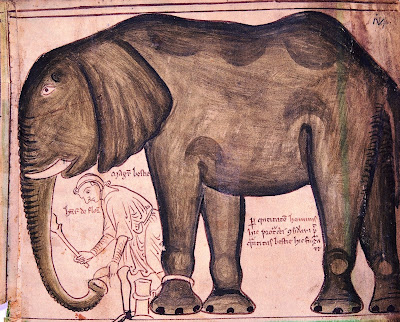
Henry III's Elephant

Matthew Paris, c1255. Parker Library, Corpus Christi College, Cambridge, UK

An African elephant arrived at Whitsand, on the coast of England, in late November 1254, a gift from the king of France, Louis IX, to Henry III of England. The elephant was said to have been acquired by Louis during a crusade to Palestine. A mandate in the Close Rolls, dated 7 January 39 Henry III (1255), orders the Sheriff of Kent “with John Gouch, to provide for bringing the King’s elephant from Whitsand to Dover, and if possible to London by water” [The New York Times, 11 June 1882].

A royal menagerie was established at the Tower of London in 1235, when Henry III received a wedding gift of three leopards from Frederick III, Holy Roman Emperor. Henry was presented a bear in 1246 by the mayor of Northampton. A Norwegian polar bear joined the menagery in 1252; it was controlled by a muzzle attached to an iron chain and, when secured by a strong rope, was allowed to catch fish in the Thames.

In 1255, Henry ordered elaborate arrangements to be made for the accommodation of his elephant at the royal menagerie in the Tower of London. “We command you,” he wrote to the Sheriff of London, “that ye cause without delay, to be built at our Tower of London, one house of forty feet long and twenty feet deep, for our elephant.”

Matthew Paris (1200-1259), a Benedictine monk of St. Alban’s Abbey, said of the beast, “We believe that this was the only elephant ever seen in England.” He drew the animal twice; the illustration posted here shows the elephant being fed by its keeper, “Henricus de Flor.”

In 1258, about three years after it began its captivity in the Tower, the elephant died—apparently the result of being given too much red wine to drink. Additionally, the chilly climate and cramped quarters likely did nothing to ensure the creature's longevity.

Sunday, January 13, 2008

Household Ordinance of Edward II, 1318


Here's a fascinating glimpse into the daily comings and goings of the king's household. This ordinance (here considerably abridged) was drawn up at Edward's request by the steward, the chamberlain, the treasurer, and the comptroller of the wardrobe, to define the duties of the various officials and to establish needed reforms in the administration of the household.

The king should have a fit steward of the household, who, if he is a banneret,[2] is to have a knight, three squires, and a clerk for the pleas that pertain to the stewardship, [all of them] eating in the hall. And each night he shall receive for his chamber a sester of wine, twelve candles, two tortis pur viu,[3] and one torch, and more when he needs them. And [he is to have] bedding for the whole year and wood for the winter season — from the eve of All Saints to the eve of Easter — [to be obtained] from the usher of the hall. And [he is to have] a livery for his chamberlain: namely, a portion of bread, a gallon of ale, and a general serving (messe de gros) from the kitchen. And [he is to have] dinners and suppers when he wants them; and as fees 20m. a year, in equal instalments on the feasts of Christmas and Pentecost. And if he is a simple knight, he shall receive fees and robes like the other simple knights of the household, and shall have two squires and his clerk eating in the hall.

A treasurer of the wardrobe, who is to have a chaplain, a clerk, and two squires eating in the hall....[4]

A chamberlain, who, if he is a banneret, is to have a knight and three squires eating in the hall....

Item, a comptroller, who is to keep a counter-roll against the treasurer of the wardrobe for all receipts and issues pertaining to the same wardrobe; and he is to witness them in the exchequer in connection with the account of the said treasurer. And he shall attend the receipt of wines in gross and shall supervise all the offices of the household, such as the pantry, butlery, cellar, larder, spicery, dispensary of oats (avenerie) and other offices, [to see] that the wines and victuals that he finds in the said offices are good and suitable for dispensing in the said household.... And he is to go into those same offices every Monday to examine the remainders [of supplies] and to see that they, with the amounts dispensed in the past week, agree with the receipts of the aforesaid week. And he shall be in the kitchen for the cutting of meat and the division of fish.... And every day, if he sees reasonable cause, he shall be present at the account,[5] together with the steward and the treasurer. And this same comptroller of the wardrobe is to have a clerk and a squire eating in the hall....

Item, a cofferer, who shall be appointed for the treasurer and shall have a clerk eating in the hall....

Item, two clerks of the counting table, well able to write and perform all duties touching the wardrobe and its account under the [direction of the] cofferer....

Item, a fit clerk keeper of the privy seal, who is to have a squire eating in the hall....[6]

Item, a clerk purveyor of the great wardrobe,[7] who should sleep on guard when he is at court. And he shall have a squire eating in the hall....

Item, a clerk of the spicery, chief usher of the wardrobe, who shall receive from the clerk purveyor of the great wardrobe the wax, napery, linen, cloth, canvas, spices, and the other things of all sorts that pertain to his office, [and this] by indenture expressly mentioning price, yardage, weight, and cost.[8] And he shall cause to be weighed the wax which the chandler is to have worked, and shall reweigh it after it has been worked. And he shall oversee and cause to be recorded by his under-clerk the liveries of chandlery made each day in the wardrobe, and on the next day he shall supervise the putting away of the torches, the great candles, and the mortars.[9] Each day he shall record the parcels of all sorts of things delivered and dispensed from his office, as counted since the day before, and he shall answer concerning them at the account of the household. And he shall oversee the carriages belonging to the wardrobe, as well for the coffers and other things of his office as for the beds of the wardrobe clerks which ought to be carried. And he shall make allowance in his roll for the carriage and transportation reasonably used in connection with the king's journeys....[10]

Item, a serjeant under-usher of the wardrobe, who shall live in the wardrobe, sleeping within its door to safeguard all the things inside it. And he shall be answerable if peril is incurred by his default. And he shall obtain from the offices the liveries for all men of the wardrobe, and he shall carry out their orders....

Item, a porter of the wardrobe, who shall carry the coffers and the other furnishings of the wardrobe to the carts, and shall load and unload them. And he shall be on the cart [while it is] on the road. And at night, if the cart is outdoors wandering through the country, he shall remain on watch....

Item, a squire fruiterer, who shall receive and take from the clerk of the spicery confections and other spiceries, and figs and grapes for the king's mouth. And each day he shall record for the said clerk what has been expended on the previous day: as well the said spiceries and fruit, thus received from the said clerk, as apples, pears, cherries, and other fruits which the said fruiterer shall purvey....

Item, a serjeant chandler, who shall receive the wax and candlewicks by weight from the clerk of the spicery, and shall have them worked according to the assize contained in the statute....[11]

Item, a confessor of the king and his companion....[12]

Item, a chief chaplain, who is to have a squire eating in the hall ... and five chaplains ... and six clerks....

Item, an almoner chaplain, who is to have a squire eating in the hall....[13]

Item, a physician....

Item, a surgeon....

Item, a clerk of the market, coroner of the king's household, who shall enforce the assize of bread, wine, and ale; also the assize of all sorts of measures, weights, and yards within the verge of our lord the king's presence. And he shall have wrongdoers who have broken the assize, or who are found with false measures, punished by imposition or fine....

Item, the king shall have a squire inspector and keeper of viands for his mouth, and an inspector of his table; also a squire to carve before the king and a squire to serve him with his cup....

Item, the king shall have two squires ushers of the chamber, one of whom shall be serjeant purveyor of wood and bedding for the office of the chamber.... And the serjeant purveyor shall have a servingman to help him in making purveyance....

Item, eight footmen of the chamber, who shall serve in the chamber making beds, holding and carrying torches, and [doing] various other things according to the commands of the king's chamberlain....

Item, the king is to have thirty serjeants-at-arms, properly armed and mounted ..., who shall daily ride armed before the king's person while he is journeying through the country, unless they have other commands from the king or the steward....

Item, a knight chief usher of the hall, who shall have charge of the door of the hall, [seeing] that it is well kept by the serjeants and valets of the usher, as is fit. And he shall take care that the hall is well and honourably served, and that no one eats there except those who rightfully should, saving always that strangers are received and honoured as they ought to be. And each day he should enter and inspect the offices of the household, [to see] that the things sent by the purveyors are sufficient according to the purchase, and that no one is permitted in the same offices except those who ought to be there. And he shall have a squire eating in the hall....

Item, two serjeants ushers of the hall, of whom one shall be purveyor of wood and of bedding for the service of the hall.[14]...

Item, two knights marshals of the hall, of whom one shall have charge of lodgings and the other shall be on duty in the hall....

Item, two serjeants marshals of the hall, of whom one shall have charge of lodgings and the other shall be on duty in the hall....

Item, a serjeant overseer of the sideboard for the hall, who is to advise concerning the places that he serves, according as persons of high estate and others may be seated in the hall....[15]

Item, a chief clerk of the pantry and butlery, who ought to keep the records of his office. And he is to respond each day at the account of the household.... He shall be present at the receipt of bread, wine, and ale; and he shall inspect and examine [them, to see] that they are of the proper weight, measure, and value....[16]

Item, a serjeant chief pantler, who shall receive the bread in gross by view of the clerk or the under-clerk, and shall each day be answerable to the chief clerk for the enrolment of what has been dispensed....[17]

Item, a serjeant pantler for the king's mouth, who each day shall receive from the great pantry the bread for the king and for his chamber, and for no other place....[18]

Item, a waferer, who shall serve the king, the hall, and the chamber with wafers, as pertains to him....

Item, a serjeant baker, who shall bake all sorts of bread for dispensing in the king's household — as well round loaves for all the commonalty as demeine loaves for the king's mouth....[19]

Item, a serjeant naperer, who shall perform his office in the king's chamber and in the hall. And he shall receive the napery from the clerk of the spicery and shall be responsible for it at the account whenever he is asked....[20]

Item, a ewerer for the chamber, who shall perform his office in the said chamber....[21]

Item, a launderer for the king's chamber, who shall wash all sorts of linen cut for the king's body ...[22] and the covers used in the service of the chamber....

Item, a launderer of napery, who shall wash all sorts of cut linen pertaining to the said office of napery, and the covers from offices connected with the hall....

Item, a chief butler, serjeant purveyor of wines.... And he shall do that which pertains to him according to the content of the statute concerning his office below.[23]

Item, a serjeant butler of the household, who shall receive and dispense all wine and ale that are dispensed in the household....

Item, a serjeant butler for the king, who shall receive from the butler of the household all the wine and ale that are dispensed in the king's chamber....[24]

Item, a chief clerk of the kitchen, who ought to make the enrolments pertaining to his office. And every day at the account in the wardrobe before the steward and the treasurer he shall be responsible for the parcels delivered [in the kitchen] and for all other matters pertaining to his office. And he shall be present at the cutting of meat and the division of fish. And he shall oversee the purchase and the cost of meat and fish and of all other things pertaining to his office, with the aid of the comptroller, the knight usher of the hall or the knight marshal, and the sewer of the king's table....[25]

Item, two serjeants cooks for the king's mouth....[26]

Item, two serjeants cooks for the hall....

Item, a serjeant larderer, who shall receive the meat and fish that the buyers cause to be brought to the larder, or which comes as a present; also the venison which comes thither from the king's huntsmen or from any other source. And he shall deliver the aforesaid meat and fish to be dispensed for the household in parcels, and [this] under the inspection of the comptroller, the knight usher of the hall or the knight marshal of the hall, the clerk of the kitchen, the sewer of the king's table, and the chief cook. And he shall keep the food on the sideboard and each day he shall give to the said clerk a record of the parcels of the aforesaid meat and fish dispensed in the manner aforesaid....[27]

Item, a serjeant poulterer, who shall attend to purchases and purveyance of all sorts of things pertaining to his office....[28]

Item, a serjeant of the scullery, who shall buy and purvey wood, charcoal, and all sorts of vessels of brass, iron, and wood that belong to the kitchen; also the pots and various other things pertaining to his office....[29]

Item, a [second] serjeant of the scullery, who shall receive the silver vessels from the wardrobe by number and weight ..., and shall keep them and be responsible for them by number and weight in the same wardrobe at the end of the year....

Item, a serjeant of the saucery, who shall buy and purvey flour for all manner of sauces and other things needed for the office of the saucery and the king's household....[29]

Item, a serjeant porter, who shall guard the door where the king sleeps, so that none may enter except those who by right should do so....[29]

Item, a chief clerk of the marshalsea....[30]

(French) Tout, Edward II in English History, pp. 270 f.

Notes

[1] On the general significance of the document, see Tout, Place of Edward II in English History, ch. v, and Chapters in Mediaeval Administrative History, II, pp. 242 f.
[2] The banneret, as opposed to the simple knight or bachelor, had the right to bear a square pennon on his lance.
[3] Large candles "for view (? display)"; see Oxford English Dictionary under tortis. Henceforth the expression will be translated merely as "great candles."
[4] All the greater officials received liveries similar to that of the steward, but with considerable variation in the particular items. Besides, each normally had his own chamberlain, who was entitled to food and drink.
[5] Drawn up in the wardrobe; see no. 52C.
[6] Also four under-clerks with liveries.
[7] See above, p. 171, n. 8.
[8] This was a newly established reform, as is explained in the next paragraph of the text.
[9] Bowls of oil with floating wicks. [10] Also an under-clerk to assist him.
[11] I.e., a separate ordinance dealing with these matters. Two serving-men under the chandler worked the wax.
[12] With four horses and three grooms.
[13] Also a clerk and a serving-man.
[14] Under the serjeants were two serving-men; under the knight was a sewer, who had charge of setting the table.
[15] He was assisted by two squires sewers, who served the meals in the hall. Besides, twenty-four squires were on duty in the hall, to carry out the commands of the high officials.
[16] Also an under-clerk, who kept tallies for all bread, wine, and ale received.
[17] Also a serving-man and two porters.
[18] Assisted by a serving-man for the chamber, and one for the rest of the household.
[19] Cf. above, p. 66, n. 3. The baker was assisted by two serving-men, one for the oven and the other for the mill.
[20] Also a serving-man.
[21] Also a serving-man, who acted as ewerer for the hall.
[22] This portion of the text is very corrupt.
[23] A separate ordinance added at the end of the survey.
[24] Also enumerated in the service of the butlery: a serving-man of the cuphouse two drawers of ale and wine, a purveyor of ale, two serving-men of the pitcher-house, and two porters.
[25] As assistants he had an under-clerk and two buyers, who were to give money or tallies for anything taken by purveyance.
[26] Under each pair of cooks were five serving-men.
[27] Under him were an usher of the larder and two porters.
[28] Three serving-men assisted him in obtaining poultry and preparing it for the kitchen.
[29] Also two serving-men.
[30] Here the text gives a detailed account of all the services connected with the king's stables. The chief clerk, assisted by a purveyor of oats, had charge of all records pertaining to the office, including tallies given for oats, hay, straw, harness, etc. The actual care of the king's horses — palfreys, chargers, pack-horses, draught-horses, etc. — devolved on two serjeants harbingers and three serjeants marshals, under whom were numerous serving-men, porters, and grooms. The record then describes the officers in charge of the king's hunting, fishing, and fowling, and lists his trumpeters, musicians, messengers, and archers. It ends with a group of particular ordinances to regulate the duties of the chief butler, the arrangement of lodgings for the court, the daily account in the wardrobe, the exclusion from the household of undesirable persons, and many other matters.

Sources of English constitutional history: a selection of documents from A.D. 600 to the present, eds. Carl Stephenson & Frederick George Marcham, Cornell University. Harper & Row, 1937, ch. 57.

Coronation of Edward II, 25 February 1308

Example of a 14th-century coronation

The Oath:

The archbishop of Canterbury put the questions before the king was crowned; and, after he had given his oral responses, he personally swore on the altar that he would keep all his promises.

"Sire, will you grant and keep and by your oath confirm to the people of England the laws and customs given to them by the previous just and god-fearing kings, your ancestors, and especially the laws, customs, and liberties granted to the clergy and people by the glorious king, the sainted Edward, your predecessor?" "I grant and promise them."

"Sire, will you in all your judgments, so far as in you lies, preserve to God and Holy Church, and to the people and clergy, entire peace and concord before God?" "I will preserve them."

"Sire, will you, so far as in you lies, cause justice to be rendered rightly, impartially, and wisely, in compassion and in truth?" "I will do so."

"Sire, do you grant to be held and observed the just laws and customs that the community of your realm shall determine, and will you, so far as in you lies, defend and strengthen them to the honour of God?" "I grant and promise them."

(French) Statutes of the Realm, I, 168

Edward II's coronation oath demonstrates the barons' distrust of Edward from the beginning. Edward was thus compelled to accept an addition to his coronation oath in which the king swore that he would observe 'the rightful laws and the customs which the community of the realm shall determine.' The interpretation of the oath has led to much debate concerning who constituted the 'community of the realm' and how it was to choose or decide.

In their declaration at Boulogne in January 1309, the barons quoted the controversial clause of the coronation oath to reinforce their demand that Gaveston be exiled—the king they said being bound by his oath to obey their decision. I suspect the enemies of Gaveston knew full well they had an ace up their sleeve with these new provisions in the coronation oath. They need only await the proper moment to make their demands. The moment was not long in coming.

'The doctrine of capacity' declared that homage was not due to the king in person but only to the crown as an institution. The Declaration distinguished between the person and the office of ruler to justify violent opposition to one if it was in the best interests of the other, and stressed the barons' loyalty to the crown.

The Ceremony and Banquet:

The Pauline annalist, claiming to be an eyewitness, gives a vivid impression of Edward’s coronation ceremony. According to his story there was some problem about the barons’ carrying of the regalia of St. Edward by virtue of their “ancient service,” since these were relics that only clergy should handle. As for the choice of Gaveston to carry the crown, this predictably aroused indignation among laymen and clerics alike. The press of people was so great that a strongly constructed internal plaster wall collapsed, bringing down in its wake the high altar together with the royal staging, and crushing to death a certain knight, John de Bakewell, who on account of his reputation as an “enemy” of the monastery was accorded little sympathy by the chronicler. In consequence the ceremonies were concluded with irreverant haste.

The same source records that the subsequent banquet, which continued late into the night, was likewise mismanaged. There was a superabundance of food but insufficient supervision of its distribution. Worse still, the banquet gave occasion for conflict. Gaveston sought to outshine the king himself by appearing in purple garments resplendent with pearls. One of the earls wished to reprove him in public but was urged not to spoil the feast by creating a disturbance. Their day would come, he was told. As for the queen’s uncles, perceiving that the king preferred Gaveston’s couch to that of the queen they returned with great indignation to France.

Haines, King Edward II. McGill-Queen’s University Press, 2003, p. 55